Chapter 1: The Architecture of Leadership
What high-performing teams actually run on, and why most leaders who have one never consciously designed it
Written for technical leaders who have stopped measuring their worth by what they personally produce, and are ready to design the system that scales.
Anthony S. Jackson, MBA
The meeting had just concluded, but Tom lingered in the conference room a little longer. The whiteboard was covered with half-erased diagrams, boxes, arrows, and question marks. Someone had sketched a rocket ship in the corner next to the word “ROADMAP.”
It should have felt productive, but something was off. They’d spent ninety minutes debating priorities, reviewing sprint metrics, and reassigning tickets. Yet Tom felt a dull tension behind his eyes, that familiar ache from meetings that felt busy but didn’t accomplish anything. He couldn’t quite identify what was wrong, and that worried him. When he looked at the board, he didn’t see clarity. Instead, what he saw fueled fears of misalignment.
Three years ago, he would’ve blamed himself. He would’ve left the room thinking, ‘If I were a better manager, this wouldn’t have happened.’ But that was before he learned to lead with Quiet Confidence and understood that calm and composure are learned skills, not personality traits.
Now, his frustration stemmed from something more profound: He’d developed the habit of staying grounded, yet the team around him still felt chaotic. The team wasn’t broken; it was operating without an architecture.
Steve, his senior developer, could debug a complex data issue faster than anyone Tom had ever met. Sam, the newest engineer, was eager and sharp. Sally brought creative solutions to every design problem. Sarah managed releases with precision. And Dave, well, Dave had opinions, the kind you needed to hear. The team wasn’t dysfunctional. They were just... unsynchronized.
Over the last quarter, Tom noticed a pattern: decisions were being revisited, priorities were subtly shifting, reviews were piling up, and projects were almost, almost, finishing on time. Nothing catastrophic. But also, nothing consistent.
It was like watching a talented orchestra without a conductor. Everyone knew how to play their instrument, but no one kept the same rhythm.
As Tom packed up his notebook, he caught himself whispering, “There’s no architecture.”
It hit him. That’s what was missing. In software, you can’t create stability through accidental design. So why did he think leadership was any different?
Why Great Teams Aren’t Accidents They’re Created Through Intentional Design
When I coach managers like Tom, this marks the inflection point at which leadership begins to take on a new shape. The initial phase, which Quiet Confidence explored, focuses on self-mastery. Quiet Confidence is not a prerequisite; it’s a posture you strengthen by designing systems. You learn to stay composed under pressure, hold 1:1 meetings that build trust, and stop micromanaging out of fear. Calm leadership does not mean absorbing dysfunction. It means refusing to let chaos pass through you unexamined.
Calm is created by design, not endurance, but once you’ve learned to return to that calm, the next question becomes: How do you extend that calm into the system itself?
That’s where architecture comes into play.
Great teams don’t form simply because people are talented or because the company is lucky. They are built by leaders who establish clarity through Communication, set rhythms through Cadence, Coach growth, nurture Culture, and ensure Continuity. Every high-performing team has an underlying structure, even if it isn't visible. You can sense it in how decisions are made, how information flows, and how team members talk about their work. Architecture removes friction before it adds structure.
When that structure is healthy, the team functions like a well-designed system: resilient, scalable, and predictable. When it’s weak, even the best individuals start to feel trapped in reactivity. Most managers inherit under-structured systems.
Tom had unknowingly reached the limit of leadership through intuition. He had gained confidence, but not in an organized way. His habits had improved, but his operating model remained unchanged.
Translating Software Principles into Leadership Frameworks
When I initially explain this to engineering managers, I remind them that leadership is like software design. In both cases, the goal is to create systems that are:
- Reliable under stress.
- Maintainable as complexity increases.
- Extensible when new needs emerge.
A fragile codebase leads to bugs, and a fragile team leads to burnout. Both stem from poor architecture.
Tom used to joke that he was “refactoring culture.” But the truth is, that’s not far off.
Every leader is writing the people equivalent of system code: rituals, processes, and communication loops. Some are clean and modular, while others are spaghetti. Note: this is not meant to diminish the individuals you’re working with into mere parts of a system. It’s intended to elevate their uniqueness and to allow you to apply the engineering principles you’re already familiar with to create a better operating environment for them, ensuring agency, dignity, and growth.
The difference is that software reports compile-time errors; teams remain silent. Instead of warnings, you encounter missed deadlines, tension in Slack conversations, or a skilled team member quietly searching for a new job.
That’s why I tell every manager: leadership is a technical skill. If you can think in terms of systems, you can lead using them. Leadership as a technical skill creates space for individuals to thrive, not conform.
I often have clients diagram their teams as if they were distributed systems. What’s the input? The throughput? The failure mode? The recovery mechanism? You’d be amazed at how quickly this approach uncovers leadership bottlenecks.
For example:
- Input might be unclear priorities or too many projects competing for attention.
- Throughput could be how decisions, feedback, or information move through the team.
- Failure mode might be how the team reacts under stress or shifting requirements.
- Recovery mechanism is how they regroup after setbacks or mistakes.
When Tom did this exercise, he realized his team’s throughput was blocked. They had data but lacked a rhythm for making sense of it. They held meetings but lacked a way to ensure decisions were followed through. They had rituals, but none connected back to their purpose. He didn’t need new tools; he needed a new structure.
Introducing the LeadershipOS™ Stack
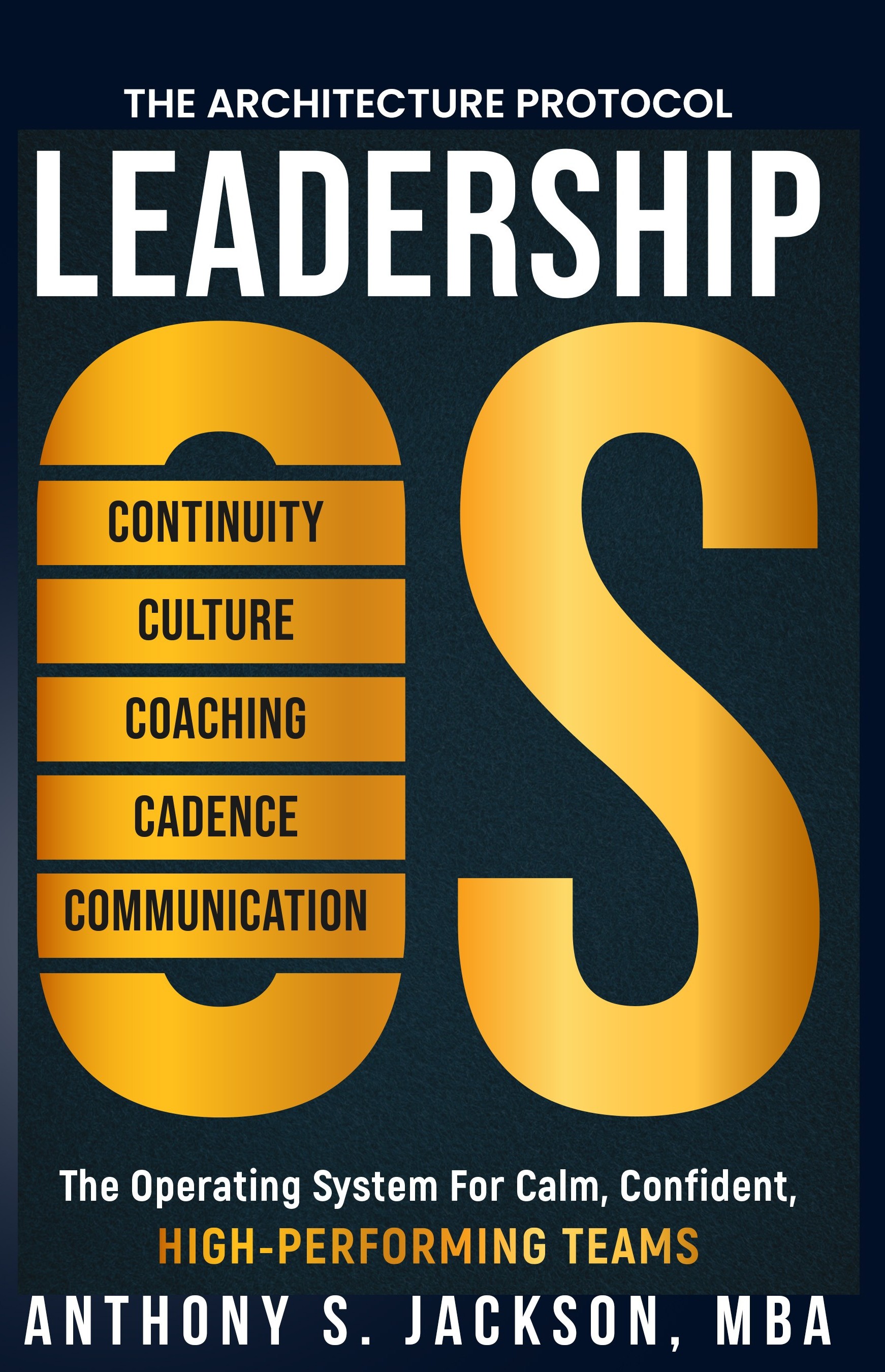
In software, an operating system connects hardware to the user, turning raw potential into coordinated functions. In leadership, your “OS” links Team Members to collective results. That’s why I developed the LeadershipOS™ Stack, the framework for high-performing teams. Each layer depends on the others, and, like any system stack, ignoring one layer causes cascading failures in the rest.
LeadershipOS™ is designed to reduce reliance on personal authority. In environments where credibility, trust, or legitimacy are unevenly granted, systems matter more than presence. Architecture carries weight when authority alone cannot.
The five layers are:
1. Communication: Define what matters and why, and ensure information flows cleanly across the system
2. Cadence: Establish the rhythms that keep work flowing and prevent drift.
3. Coaching: Develop individuals so the system becomes self-correcting.
4. Culture: Shape how people interact, decide, and behave when you’re not in the room.
5. Continuity: Preserve the lessons and mechanisms that sustain performance over time.
I’ll go deep into each in the chapters ahead, but here’s the essence:
You’re not just managing people; you’re maintaining a living system.
Tom’s leadership wasn’t broken; it was under-structured. He had personal understanding, but hadn’t translated it into Communication that the team could operate from. He had good intentions but lacked operational rhythm. He had trust but no consistent reinforcement.
As I told him in one of our sessions, “You’ve evolved beyond managing people day-to-day. Your next challenge is managing the system that manages the people, reducing direct control, removing friction rather than adding oversight.” That clicked with him. It’s the moment when most managers stop seeing leadership as heroics and start viewing it as architecture.
The LeadershipOS™ Stack (Deep Dive)
When Tom and I began mapping out his leadership system, we sketched it as an architecture diagram on a whiteboard because that’s exactly what it was. The team was the application, his rituals and communication patterns served as the APIs, and he would oversee the architecture design and his team’s evolution of it, ensuring everything integrated smoothly.
1. Communication: The Foundation Layer
Communication is the specification layer of a reliable system. Without it, everything else becomes guesswork.
For a team, Communication means three things:
- Everyone knows what matters most.
- Everyone knows how to decide when priorities conflict.
- Everyone knows why their work exists beyond the ticket in front of them.
Tom realized his team’s biggest misalignment wasn’t technical; it was contextual. Each team member had a slightly different understanding of what “success” meant that quarter. One thought it meant shipping features, another believed it meant customer satisfaction, and a third aimed to optimize code quality. While each perspective was valid on its own, collectively they caused chaos.
Tom improved communication by creating a one-page document that addressed three questions:
1. What’s our purpose this quarter?
2. What does good look like?
3. How do we know when we’re done?
Clear Communication builds clarity, and clarity builds trust; when Communication is weak, friction rises, and productivity suffers.
2. Cadence: The Rhythm Layer
Communication provides direction; Cadence drives movement. Without a consistent pulse, even the best systems stall. Cadence is the heartbeat of your team, how often you meet, how quickly feedback loops close, and how consistently you track progress. The goal isn’t the number of meetings, but the quality of the rhythm.
We established Tom’s team cadence with three simple loops:
- Weekly: Tactical syncs focused on obstacles and commitments.
- Biweekly: Demos to show progress and celebrate learning.
- Quarterly: Strategic retros to recalibrate direction.
When cadence is healthy, the team feels like a steady, unhurried pulse. Without it, priorities shift, and energy turns to confusion.
3. Coaching: The Growth Layer
This is where many technical leaders stumble. They optimize the system but forget that people power it. In software, you patch and upgrade your components; in leadership, you do it through coaching.
Tom had regular one-on-ones, but they were reactive and focused on blockers rather than growth. We shifted his conversations toward building capability.
- “What decision did you make recently that stretched you?”
- “Where did you feel underutilized?”
- “If I stopped giving you direction, what would you take ownership of?”
Coaching turns employees into multipliers. It shifts the focus from being the primary problem solver to extending execution authority to the team to handle issues independently. Investing in coaching reduces the burden on the system because every problem you help someone solve on their own is one less problem waiting for you.
4. Culture: The Trust Layer
If communication defines what we do and cadence determines when we do it, then culture shapes how we do it, especially when no one’s watching. LeadershipOS™ sees culture as the caching layer of leadership. It stores values in the team’s collective memory, enabling decisions without constant oversight.
Tom’s team valued autonomy, but without clear norms, that autonomy led to fragmentation. So he defined what autonomy truly meant:
- You can make decisions independently if they don’t block others.
- If they do affect others, you communicate before acting.
- Disagree, but don’t delay; decide and learn.
By defining culture, we didn’t limit freedom; we amplified it. Freedom without defined constraints causes chaos, while constraints without autonomy creates bureaucracy. Leadership exists in the balance between these two.
5. Continuity: The Legacy Layer
The final layer is continuity, the system’s memory. In code, it’s documentation. In leadership, it’s institutional learning. Without continuity, teams regress after each release, reorganization, or leadership change.
Tom implemented “learning loops” for his team, short debriefs after major milestones. Each captured what worked, what didn’t, and what we’d repeat. It wasn’t a formal postmortem; it was a living logbook.
Continuity preserves wisdom. It helps new employees onboard more quickly, helps veterans avoid repeating errors, and helps leaders build on past knowledge instead of starting over. The result?
Stability that builds over time. While we’re using the metaphor of an operating system to talk about our Teams as a “system”, let’s not lose sight of the real value in this. Creating a stable system where everyone understands their role, boundaries, and expectations leads to trust, energy, psychological safety, and ultimately job satisfaction. You can start anywhere, but you stabilize fastest by shoring up the lowest weak layer first.
Diagnostic Check: Assessing Your LeadershipOS™ Stack
Before we proceed, take a moment to assess your own LeadershipOS™. Reflect carefully, this isn’t a test; it’s a diagnostic for your system.
Communication: Do your team members clearly understand what success looks like this quarter, and can they describe it in the same way you do?
Cadence: Do you have a rhythm for communication, decision-making, and reflection, or do you rely on urgency to prompt interaction?
Coaching: Are you developing leaders or just managing executors?
Culture: When you’re not in the room, do your team’s decisions still reflect your values?
Continuity: If you leave tomorrow, how much of your team’s knowledge would go with you?
These moments of reflection help you troubleshoot your leadership system. Every leader faces bottlenecks; your job isn’t to eliminate them all at once, but to focus on the one that limits throughput today.
Upgrade Script: Draft Your Leadership Blueprint 1.0
Now it’s your turn to design. Think of this as your Leadership Architecture Diagram, your Blueprint 1.0. You’re not building your system today. You’re just seeing it for the first time. Grab a sheet of paper or open a blank page in your notebook. Answer each coaching prompt honestly; don’t worry about polish. You’re mapping your system, not presenting it.
Communication Prompts
- What’s the one sentence that defines your team’s purpose?
- How do you know when your team has succeeded this quarter?
- What signals confusion for your team, and how do you detect it early?
Cadence Prompts
- What are your team’s recurring rhythms (weekly, monthly, quarterly)?
- Which rhythm is missing or inconsistent?
- If your team were a heartbeat, what would a healthy pulse feel like?
Coaching Prompts
- Who on your team is ready for more ownership, and how will you make space for it?
- How do you measure your success as a coach, not just as a manager?
Culture Prompts
- What three words describe how your team behaves when you’re not around?
- What invisible rules guide (or misguide) your team?
- What’s one cultural habit worth institutionalizing?
- What’s one capability you want your team to build without you?
Continuity Prompts
- How does your team capture lessons learned?
- What process ensures that wisdom survives turnover?
- What would future-you thank present-you for documenting today?
Once you’ve answered these, visually map out your LeadershipOS™ Stack with five horizontal layers, each labeled with a few key bullet points. You don’t need artistic skill; clarity is what matters. Seeing your system on one page helps you lead it intentionally.
Keep this Blueprint visible for the next 90 days. Treat it as a living document. As you read the upcoming chapters, you’ll update and expand it, transforming it from version 1.0 into a more robust and scalable version.
The Architecture of Leadership
Quiet Confidence stabilizes the leader. It does not stabilize the system. Great teams are not the result of talent and effort alone, they are the result of intentional design. This chapter installs LeadershipOS™ Stack: five interdependent layers (Communication, Cadence, Coaching, Culture, Continuity) that explain how high-performing teams function as integrated systems. When work feels chaotic, the issue is almost always structural. Your role is no longer to be the center of execution it is to design the conditions that enable execution to thrive.
Up Next: From Heroics to Systems Thinking
In the next chapter, we’ll examine why heroics feel productive but quietly undermine leadership at scale. You’ll see how constant availability, quick fixes, and personal output can create hidden dependencies that keep teams reactive.
Tom learns to replace adrenaline with predictability, shifting his focus from fixing problems himself to increasing the team’s overall throughput. Instead of being indispensable, he designs systems that enable progress without him.
This is the turning point where leadership shifts from response to reliability.
Delivered to your door. One-year guarantee.
Not ready yet? I write about technical leadership every weekday, one idea from inside the framework, nothing motivational, nothing generic.
You can unsubscribe at any time.
No spam. No sharing your information. If it stops being useful, you should leave.